Trail
Vertical-km
3.8 km
Trail
Vertical-km
3.8 km
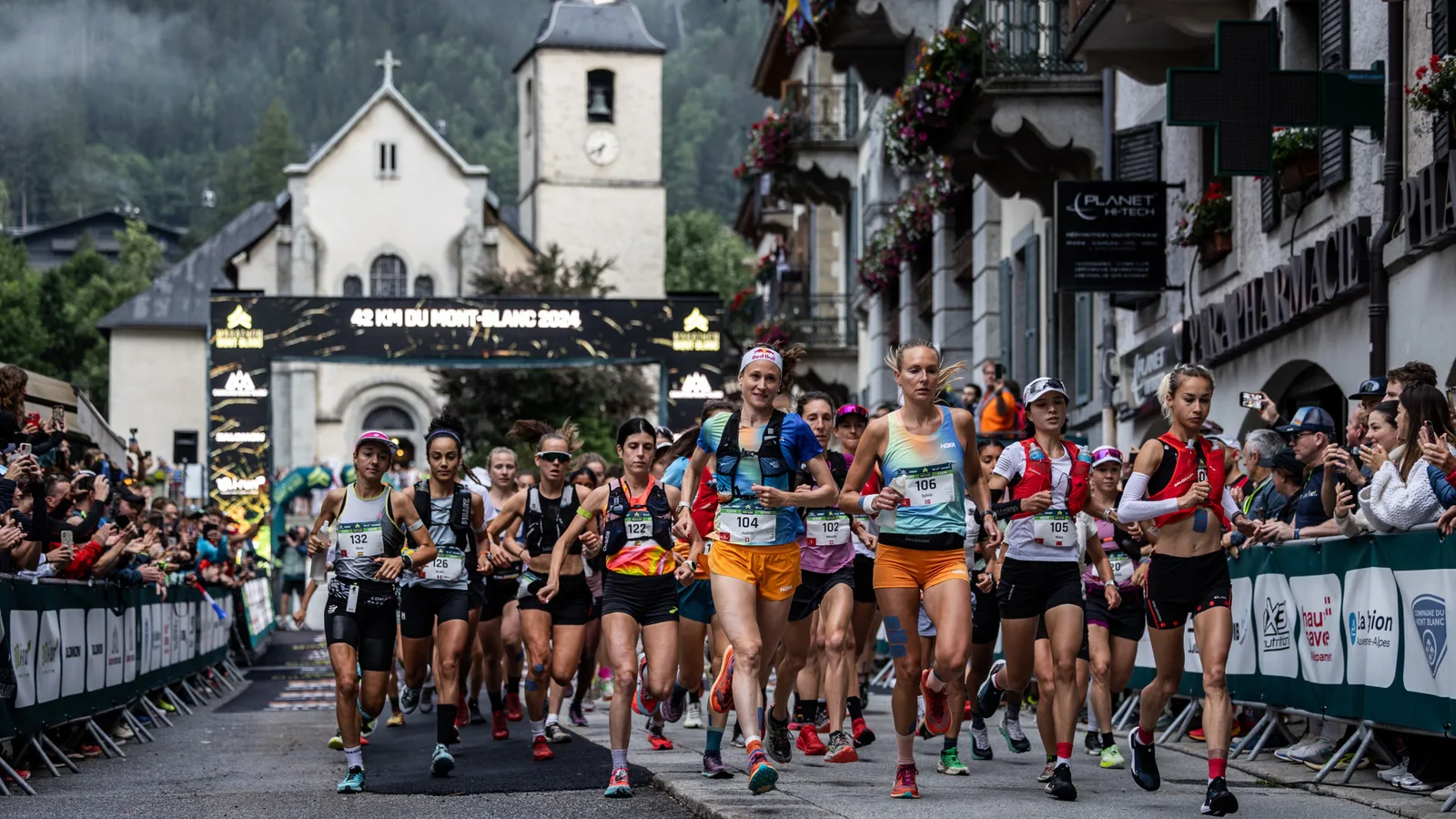
Marathon du Mont-Blanc — one of the flagship races of the UTMB World Series, set in the Chamonix valley with iconic Mont-Blanc views.
On-course hydration and energy stations (e.g., water, isotonic drinks, gels) are provided at regular intervals; specifics will be published closer to event day.
Pacemakers will be present with target times displayed per start wave on race day; Pacers help runners maintain goal pace and will carry flags to be visible during the race. See the 'Race day' information for target times per start wave.
Monthly averages based on historical data (2000–present).
Register on the official organiser website.
Sign up nowThe UTMB Index Score is calculated using a statistical algorithm based on the runners finish time for that particular race course. The distance, positive elevation gain and negative elevation gain for that race are used to identify similar races in our database already completed by runners in this race. These races then form the basis of statistical calculation to determine a UTMB index score specific to this years edition of this race.
Finish times in Trail Running are influenced by many different factors, including the technicality of the terrain, heat ,wind, rain, altitude, time of day etc.. Our experience shows that it is not possible to quantify the technicality of a race, so instead we have created a calculation method based on statistical analysis of the results and runners in that race based on our database of more than 11,4 million individual results. The same level of technicality is applied equally to all runners in that race for each particular edition of each race. This method has two major advantages: It allows us to consider any factor that can affect race time, if the conditions slow a race down then we can idenify this in the results. Our database and scoring system continuously improve as we gather more race data.
No, the Score for a race for a given year remains constant. Unlike your overall UTMB Index which changes and evolves over time with new results and older results no longer being counted. Having different scores for the same race over different years is quite normal as this accounts for the changes in conditions and tracks between the two. This allows for comparison of your different race Scores across different races and years.
There are often differences in the distance and elevation for a particular race depending on the type of device used to record the track and the GPS calculation method. The UTMB Index uses the distance and elevation solely as the starting point for the statistical analysis, therefore slight discrepancies in the listed distance and elevation compared to the official race site or your own recorded data do not impact the UTMB Index Score for a given race.
It is normal for different years of the same race to have different scores attributed for the same time. Even if two different years races have the same track, there are other outside factors that can influence the UTMB index score such as heat, wind, aid stations, compulsory materials, track condition etc. Our statistical calculation method takes these different aspects into account indirectly by looking at the different finish times for all participants and assigns the Score accordingly. On very rare occasions, the calculated score for a previous edition may be too high due to incorrect information, errors in the results or lack of recent results for these runners. In the spirit of fairness we don't want to penalise runners when we discover these errors, which could be days, weeks, or even months later. Therefore, the slightly high score will be maintained, and the next edition will be adjusted to the correct level. Our main goal is to enhance the accuracy of the UTMB Index to standardise different races worldwide. To achieve this, from time to time races will be adjusted in the current year to better align them with the actual race level. This ensures that certain races don't become easy high-scoring opportunities that don't reflect actual performances.
The Score is not influenced by the runner's position or ranking in the race, it is solely a measure of the speed of the runner, if you are first place or 10th place your Score does not change.
Our years of experience tell us that two races which may be advertised with the same distance and the same elevation profile, but in reality differ quite considerably. Our statistical correction coefficient makes allowance for these differences as well as many other technical aspects, it is for this reason that the UTMB Index was created.
This means that the result has been entered into our database, but the score is still being calculated. The time it takes to update and calculate scores depends on the number of results to be processed. We strive to process the results as quickly as possible, but during the peak race season, it may take longer than usual due to the manual verification step in our calculation process.
A Score is calculated for all races on our calendar when we receive complete and accurate result files from the event organizer. However, please note that no score is calculated for the following races: "Vertical KM" races Virtual Races Races where the total effort (distance km + (elevation profile/100)m) is less than 20 (e.g. 15km + 400m = 19km effort) Back-Yard Ultra or elimination style races Races with an insufficient number of finishers to establish a reliable score Races with result files that contain too many errors to determine which runners participated.
The UTMB Index is a tool for evaluating the performance of a trail runner based on their speed. The UTMB Index can be used to compare different trail runners around the world and in their ability at different distances based on their UTMB Index.
If a runner has completed at least one race in the past 24 months then they will have a valid UTMB Index. If a runners has never completed a race or their last race is outside this time period then they will not have a valid UTMB Index. The same rule applies to a UTMB Index by race category. See the full list of benefits for runners with a Valid UTMB Index
The UTMB Index is calculated from the weighted average of a runners best scores, up to the top 5 are taken into account. Runners must have at least one score from races completed in the past 24 months for their utmb index to be valid, if their utmb Index is valid then all their results from the past 36months are used to calculate their UTMB Index. The best result is given the highest weight, and the weight progressively decreases for the subsequent four results. Newer results receive higher weight than older results.
To allow the UTMB Index to be open to as many people as possible, as soon as a runner has completed one race they will receive a UTMB Index. Their UTMB index will be given a slight negative weighting compared to someone who has achieved 5 results. This gives an advantage to runners who have multiple performances, while allowing inclusion of runners with less than 5 results. This is similar to other sports where you need to have several results to consolidate your performance level.
Recent results are counted as more important than older results when calculating the UTMB Index. When a result is greater than 12 months old a negative weighting is applied which reduces its value.
Your UTMB Index is recalculated every 24 hours taking into account all the results in the relevant time period. As your result get older they will carry less weighting in the UTMB Index calculation and your UTMB Index will naturally decrease (unless you have new results coming in).
At the bottom of every runner profile on utmb.world, you will find an interactive chart that allows you to gain a better understanding of your UTMB Index. You can apply filters to view gender, age group, and country-specific data and graphs. This enables you to see how you compare to other trail runners in your category and country.
The general UTMB index uses the best results across all races greater than 20K. The UTMB index by category uses the best results only in that specific category. For a versatile runner, often their best 5 races will be spread across several different categories, which gives them a better result in the general index than they would have for each individual category.
The UTMB Index is recalculated for everyone once a day, taking into account all the results received during the day, hence scores will not be immediately included in your UTMB index. Please check again tomorrow. If your UTMB Index has not changed after a 24hours, it is because the new score is not significantly different from your existing scores to make an overall change. Please be assured, the calculation will always give you the best possible UTMB Index looking at all your results.
Your UTMB Index won't be affected by a slow race or a DNF! If a score from one race is much lower than your previous results, it won't be used in calculating the UTMB Index. We believe that significantly lower UTMBs should be disregarded since the UTMB Index is intended to measure speed. Technically, your UTMB Index is calculated using your best 1, 2, 3, 4, and 5 results, comparing them to reward you with the highest score. This approach benefits runners with multiple results while not penalizing them for a single bad results.
Yes, the UTMB index calculation is identical for men and women. This means that you can directly compare the speed of men and women across different races, similar to comparing finish times in other sports.
Your UTMB index is based on your race scores, to improve your UTMB index, you can: Improve your individual scores. Obtain more race results (up to 5) and ensure you have new results. Older results are not weighted as much as new results. If you want to improve your score in a specific distance category, participating in more races of that category will help. Keep in mind that different trail races have various styles and conditions that can affect your performance. If you choose races that align with your preferred style or where you can perform relatively better compared to your competitors, you will achieve a higher score. For instance, the same runner may attain different scores on flat versus mountain races or technical terrains.
The UTMB Index relies on a network of race organizers worldwide. They submit the results for inclusion in the UTMB Index. By accepting results exclusively from race organizers, we can maintain accuracy and ensure complete and correct files, attributing results to the respective runners who participated in each race.
We only accept results from race organizers as they possess access to the comprehensive results that allow us to score and assign the result to the correct runners.
Race results meeting our quality criteria are typically published on our website within an hour of being submitted by race organizers. Some results may require manual validation, which is usually completed within one working day. Once published, the UTMB Index undergoes manual validation for quality purposes, which can take 1 to 3 days. During peak periods, this process may take longer, we apologize for the delay and strive to have the scores released as quickly as possible.
Your race results are submitted by your Race Organiser after your race. We will automatically match the information in the results with our database, if there is a match then the results will be automatically added to your profile. If there is no match then we consider this a different runner and there will be a new profile created for this result and you will need to manually request to link the result to your account. To ensure the automatic allocation of results functions correctly please ensure that your personal information in your My UTMB account and your race registration are the same.
Last updated: Jun 5, 2026, 11:43:54 PM
We'll email you when races match your filters. No spam — only what fits your goals.
On your marks
Loading race details…