Laufen
Marathon
42,2 km
Laufen
Marathon
42,2 km
The Antarctic Ice Marathon®, the world's southernmost marathon, is organized by Runbuk Inc. In addition to organizing the world's most southerly marathon, Runbuk organizes the world's most northerly marathon, the North Pole Marathon®, and the 777 World Marathon Challenge® (7 Marathons 7 Continents 7 Days®).
Aid stations provided hot drinks, soups, snacks, and medical personnel.
Participants aim to complete the marathon within a 10-hour limit, with the race offering pacing support for racers to achieve their personal best times.
There have been 20 Antarctic Ice Marathon races to date.
The 2026 Antarctic Ice Marathon / Half Marathon races are scheduled to take place on 13 December 2026. See the Race Schedule section for complete details.The 2026 race marks the 21st edition of this epic event.
The fee for the 2026 Antarctic Ice Marathon is $22,500. Please note that places are limited in accordance with aircraft capacity constraints and are allotted on a first come first served basis.
No. Although the races are often operated in a very timely fashion, you are going to one of the most difficult places to fly to in the world. Days of delay can be normal for Antarctic flights and you should not plan anything important for a minimum of two weeks after your expected return. Allow yourself time to enjoy this unique experience without the stress of time pressures. Of course, every effort will be made to keep to the scheduled departure and return date, but all flights are subject to weather, aircraft serviceability and local conditions. The 2019 event was operated exactly to schedule.
Our departure point for Antarctica is a town called Punta Arenas in Chile, South America. You will arrange round trip flights from your homeland to Punta Arenas. From there, you will be flown to the Union Glacier camp in Antarctica.
You will book your international flight to arrive in Santiago, the capital of Chile. There are regular internal flights from Santiago to Punta Arenas via the Lan Chile airline. Due to the possibility of delays, you should essentially ensure that there is flexibility with your return date.
The official race hotels are the Diego de Almagro and Almasur Hotel, where preferential rates will be obtained for Ice Marathon participants. However, competitors can choose from a range of other hotels with prices from US$50 - US$300 per night depending on quality and services. When booking a hotel, bear in mind that your budget should cover the possibility of being stuck in Punta Arenas for several days before the jet actually takes off for the Antarctic.
A Boeing 757 passenger airliner will fly you to the Union Glacier camp at the foot of the Ellsworth Mountains in Antarctica. It’s a 4-hour flight that will see you fly over the Strait of Magellan, Tierra del Fuego and the Drake Passage before getting your first glimpse of frozen seas below. At 66 degrees latitude you will cross the Antarctic Circle and continue towards the icy continent. The ice sheet will continue to stretch inland until you see the spectacular Ellsworth Mountains. We will land on an ice runway at the southernmost extension of these mountains - 80 Degrees South.
Yes. The event is is a foot race and naturally promotes fitness and exercise as a substitute to car and vehicle use. Activities in the Antarctic are governed by the Antarctic Treaty and associated agreements, referred to collectively as the Antarctic Treaty System, As part of the system, the Environmental Protocol was adopted in 1991, which applies to government activities, non-government activities, as well as tourism and sports, to ensure that these activities do not have adverse impacts on the Antarctic environment, or on its scientific and aesthetic values. It should also be highlighted, to avoid misconceptions, that the emissions resulting from a 4-hour return flight to the Antarctic are identical to those of a similar flight elsewhere in the world. Moreover, climate change is a global phenomenon and we also encourage others to offset their carbon emissions.
The logistics company’s activities are subject to detailed risk management and contingency planning that allow for the remote and harsh Antarctic environment. Preparations include detailed emergency planning and equipment to deal with all eventualities. The team is known for their experience and expertise. The Union Glacier camp has a basic medical clinic staffed by a doctor and medic who specialize in emergency and remote medicine. Support personnel keep a 24-hour watch and are ready to respond at any time in case of emergency. Established procedures and communication protocols and continued investment in equipment and technology all contribute to a safe and enjoyable experience.
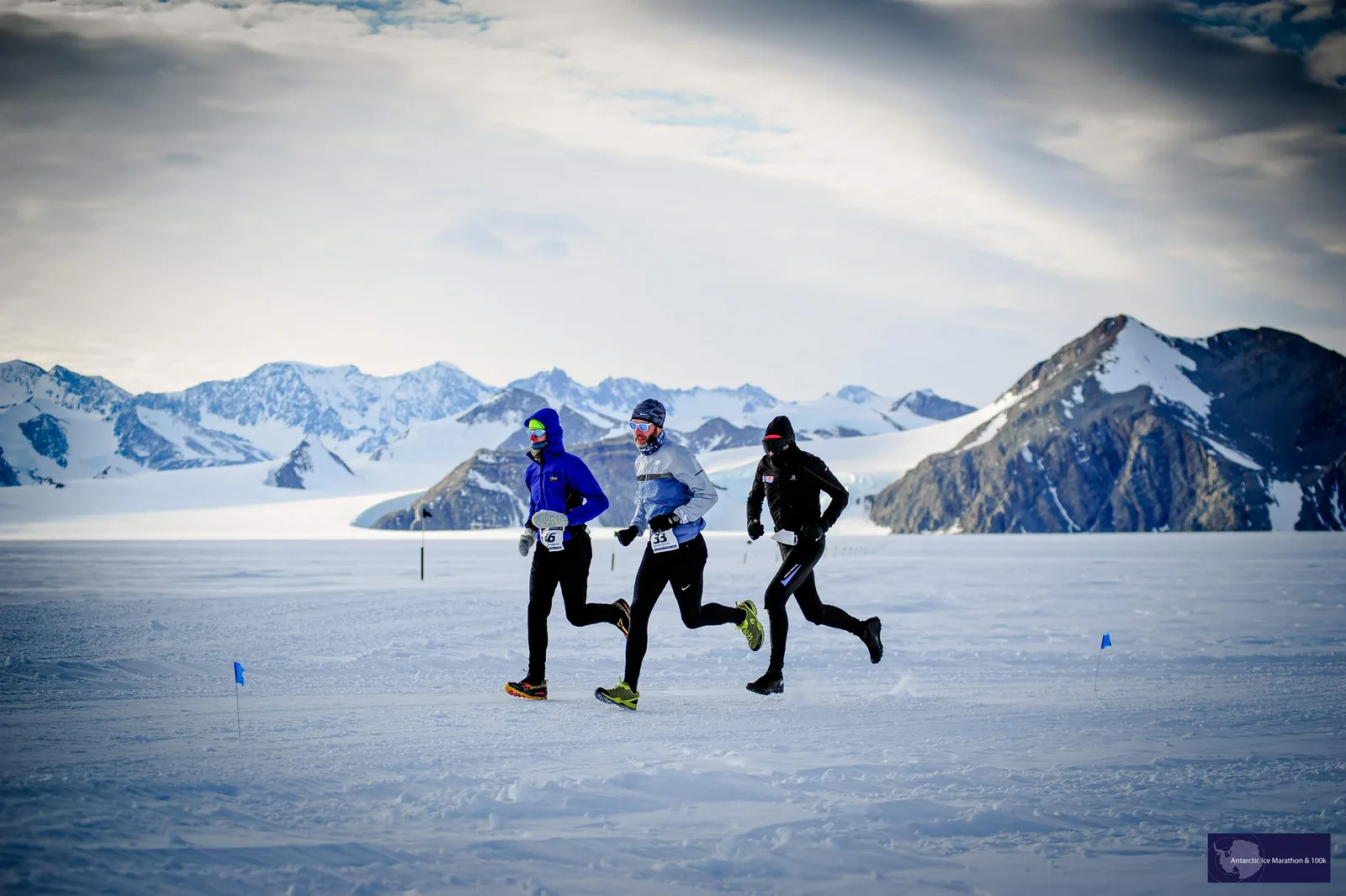
The marathon race will be run in the vicinity of the Union Glacier camp, normally on a 10.55km loop that is repeated four times. There will be an aid station every 5km.
Transfers to and from Punta Arenas airport, Chile for Antarctic flightBriefing in Punta Arenas one day prior to departureRound trip flights from Punta Arenas to AntarcticaMeals and accommodation while in AntarcticaA Baggage allowance of up to 55lbs (25kg) on Punta Arenas-Union Glacier flightEntry to your race of choiceMedal, t-shirts, patches and other souvenirs of the raceProfessional photos for personal use (and local publication)
Commercial flights to and from Punta ArenasTransfers to and from Punta Arenas airport (except for Antarctic flight)Meals and accommodation in Punta ArenasPersonal equipment and clothingExpenses incurred in Punta Arenas due to delaysAny excess baggage costs over confirmed baggage allowanceCost for the use of satellite phone whilst in AntarcticaInsurance coverage – personal, medical, or otherwise
Yes. Proper clothing should ensure the cold is not a completely overwhelming problem when running or walking these races. You will be fully advised on what to wear and your clothing will be checked for suitability prior to leaving Punta Arenas. A number of aid checkpoints are available on the course as well as one large heated structure at the half-way point. Some participants will probably never have encountered extremely cold conditions before travelling to the Antarctic, though it is preferable that you would have such experience.
Yes. Flags will guide athletes around the course and participants should be visible at almost all times. However, it is important to keep your peripherals covered and to be alert to any signs of frost damage.
Yes, it's possible. If you are determined, train properly and can run or walk a distance of 42.2km (26.2 miles) very comfortably, then you should be able to complete the Antarctic Ice Marathon successfully. One of the priorities of the organiser is to have everybody finish the race and the cut-off for the marathon is a generous 10 hours.
You can make outgoing phone calls from Union Glacier Camp using Iridium satellite phones available at the Camp. Pre-paid phone cards can be purchased at either camp at a cost of circa USD S40 for 20 minutes. Some participants choose to bring their own Iridium satellite phone and charging system. Regular cell phones and other satellite phones (e.g. Globalstar) do not work at these latitudes.
Since 2023, our marathon team has accessed the internet in Antarctica through Starlink, enabling basic emailing and web browsing. Internet connectivity via Starlink is expected in 2026, but be aware that speed may fluctuate based on weather conditions.
It will be possible to have a basic body wash / shower after the event. Many competitors additionally bring pre-moistened towellettes for a daily quick freshen-up. Anti-bacterial hand-gel is also available for hand cleaning.
The temperature at Union Glacier typically ranges from –10C to –20C at the time of year.
The course will be groomed before the race and it should comprise a reasonably solid ice surface. However, it can also be comprised of soft and loose snow in places, and both features may be evident on the circuit.
A pair of trail running shoes will work out best.
A layering system is best, which should incorporate the following:Upper body – thermal layer, fleece layer and outer windproof shellLegs – thermal layer and windproof pants Hands – pair of gloves and mittensFeet – sock liners and woollen socksHead – balaclava, facemask, hat, neck gaiter, gogglesPlease see the Race Gear section of the website.
Yes. Leading international sports photographers and / or TV have been present at all previous races and the event receives substantial global media coverage.
Zuletzt aktualisiert: Jun 6, 2026, 12:27:18 AM
Wir mailen dir, wenn Läufe zu deinen Filtern passen. Kein Spam — nur passende Rennen.
Auf die Plätze
Racedetails werden geladen…